While the Reserve Bank and the Economic Survey of the finance ministry have projected India to grow at 6.9 per cent and 6.5 per cent in current fiscal, the International Monetary Fund estimates it to be 6.6 per cent.

The BJP still does not have a majority in Upper House of Parliament, the Rajya Sabha, and this will pose hurdles to the party's legislative reform agenda

In the new decade, the scene will change because the banks till recently had been challenged by the fintechs, but the techfins have now entered the arena, observes Tamal Bandyopadhyay.

Record liquidity infusion by the central bank in the banking system during the financial year 2020-21 amid sluggish economic activity resulted in banks investing more in safe government papers than in extending loans, data from Reserve Bank of India (RBI) showed. This trend has not been seen in nearly two decades, barring 2016 - the year of demonetisation.

The consumer durables segment declined by 23.4 per cent in June, as against a dip of 10.1 per cent a year ago.

'The temptation of governments, to have a finger in the RBI pie will be just too great to resist, unless extensive amendments are carried out in the RBI Act treating it almost as the fourth branch of the government.'

Industrialists affirm their belief that the adverse effects of demonetisation and the goods and services tax are finally over.

Observing that India's worsening COVID-19 situation and the strict measures to contain it have hit the economy hard, the rating agency said productive capacity has been severely disrupted since the start of the pandemic.

Sanjay Mathur, managing director and head of economics research for Asia Pacific (ex-Japan), Royal Bank of Scotland, tells Business Standard that in the emerging market pack, India needs to learn lessons from Korea and Taiwan, which have managed their economic situations well.
With this subdued forecast, India is likely to record its worst growth performance since the 1991 liberalisation. However, it is among the only two major economies, which will register a positive growth rate in 2020. The other being China, for which the IMF has projected a growth rate of 1.2 per cent.
The simultaneous decline of several trade-related indicators should put policy makers on guard for a sharper slowdown.
The truth can no longer be hidden despite 'headline management' by the ruling dispensation, the opposition party said.

Fitch Ratings director Thomas Rookmaaker said India's debt-to-GDP ratio is likely to rise to 76 per cent from 70 per cent currently due to wider fiscal deficit and low economic growth.

Substantial gains can still be made with good policies and initiatives.

No discrimination on basis of gender, age, religion, caste and physical ability.

Markets ended weak tracking the expiry of April derivative contracts.

The country's economic growth hit a decade low of 5 per cent in the last fiscal on account of poor performance in the farm, manufacturing and mining sectors.
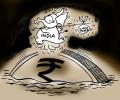
India's public debt ratio, which remarkably remained stable at around 70 per cent of the GDP since 1991, is projected to jump by 17 percentage points to nearly 90 per cent because of increase in public spending due to COVID-19, the IMF said.
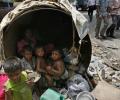
Many factors have been identified as key drivers of the inequality between rural and urban areas in China and India.
While naysayers say the economy is on a downward spiral, optimists point out that India has experienced a shift of gears in the realm of policies, thanks to several initiatives of the Narendra Modi government, says Ashok K Lahiri.

Economist Dale W Jorgenson declares that India is doing "very, very well" and forecasts that India might continue to outrun world economies, including China over the next many years.

At a pre-Budget meeting, the FM was asked to ensure that NBFCs come out of the liquidity crisis they are facing with the help of RBI. They also spoke about the futility of trying to achieve a 3 per cent fiscal deficit target over the medium term.

Determining the direction of the dollar in Trump's America will be more critical for asset allocation than getting your call on interest rates right, says Akash Prakash.

'Common sense says if one can afford, servicing the loans during this period is a better bet than postponing it by three months,' says Tamal Bandyopadhyay.

The Economic Survey called for improving business environment.

IMF said in 2017, India is likely to grow at the rate of 7.2 per cent instead of the earlier projected 7.6 per cent.
'The economy may not improve unless you admit there are some problems.'
Credit rating agency Crisil observed in its report that some 'high frequency indicators go out of whack' as credit growth and service tax collections are not in tune with the CSO's growth projections.

The upcoming general elections will be the focus and the economy and market performance will pivot around that event. The general consensus is that the India stock market should be up around 10 per cent by the end of the year.

Indian economy is doing well and the performance of domestic stock markets is not as bad as that of other nations.

The muted CPI inflation print at 5% earlier this week, followed by a similar WPI number released Wednesday, seems to have spurred India's central bank into action, is how the economists are reading into Reserve Bank of India governor Raghuram Rajan's 25 basis point cut in repo rate.

'I feel now we have a leader who is non-corruptible.' 'But he needs time as corruption is deep-rooted in our society, and people have no shame about being corrupt.' 'It will take at least 7 years to make some changes.'
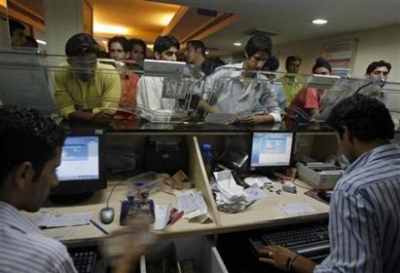
Private banks are assumed to be more efficient at intermediating between depositors and investors.

'I am sure Dr Patra will get the fullest cooperation from the finance minister who needs workhorses, not prima donnas constantly looking to improve their CVs,' says T C A Srinivasa-Raghavan.

Delivering a public speech hours after the RBI launched a rescue act for Yes Bank on March 6, Governor Shaktikanta Das reiterated the RBI's affirmation to do whatever was needed to combat the coronavirus impact. On that day, India had only one confirmed COVID-19 infection, the World Health Organisation was five days off from declaring it as a pandemic and the financially debilitating lockdowns were not even on the horizon. Das' promise on efforts to mitigate COVID-19 impact appeared as a footnote in news reports from the event.

'Q1 is going to bear the brunt of the second wave, exposing full-year GDP forecasts to downward revisions, unless phase-3 of vaccination is executed quickly.'

The Sensex closed higher by 170 points at 26,128 and the Nifty rose 59 points to end at 7,943.

'The economy will pick up in 2020 or a little later... When it picks up, will it reach 10%, 8% or still lower? It all depends on how realistic are the diagnosis and the prescriptions that follow,' says Professor K J Joseph.

India has just had one of the worst quarters in export earnings.

The last three prime ministers who served full terms started out in their early 70s. Mr Modi is younger and fitter than all of them. But he needs to find it in him to change course if he is to beat the odds, notes T N Ninan.
